
Telegram Trading Signals Tested With AI
850k messages, 19 channels, a pre-registered experiment, and an AI that argued with itself — using AI to find the truth.
Copy-trading Telegram signals is one of the internet’s most seductive promises. Thousands of channels. Screenshots of “90% win rates.” One tap to mirror a professional. If even one of these people had a real edge, following them would be free money.
So we tested it. Not with an opinion — with an AI pipeline pointed at 850,000 messages across 19 channels over 8 years, and one question:
Does anyone’s edge actually survive being copied by a normal person, after real-world execution and costs?
This is the story of that investigation, and why the honest answer matters more than a convenient one.
The pipeline
We didn’t read messages by hand. We built an agent workflow that:
- Ingested full history from public and joined channels into a local database, idempotently.
- Parsed human trade-talk into structured data with an LLM — entries, stops, targets, direction. This is harder than it sounds: one trader we studied narrates his trades live in Danish stream-of-consciousness. Regex is useless; a language model reads it perfectly.
- Matched every signal to minute-level price data for gold, US30, NASDAQ, DAX, and FTSE.
- Measured returns the way a real copier fills — at the open of the next bar after the message, never with a price the copier couldn’t actually have gotten.
That last point turns out to be the whole ballgame.
Finding 1: The crowd is a coin flip
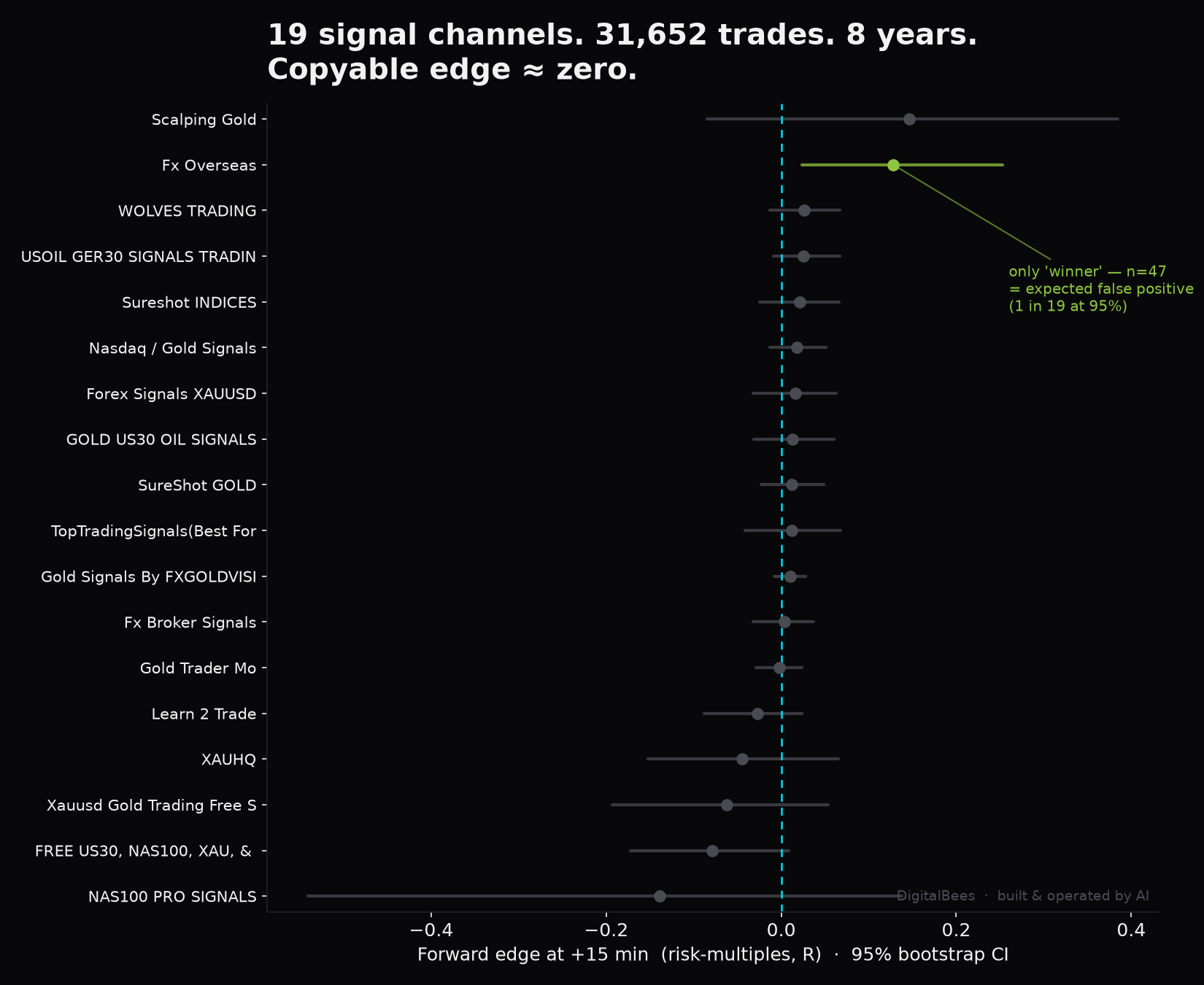
Across 31,652 clean signals from 19 channels, we measured forward return in risk-multiples (R = distance from entry to stop), with copier-realistic fills and a 95% bootstrap confidence interval per channel.
The result: the average edge is approximately zero. Win rates ranged from 40% to 56%. Every channel’s confidence interval crossed zero — except one, on a sample of just 47 signals.
When you test 19 channels at 95% confidence, you expect about one false positive by pure chance. That lone “winner” was exactly that. Meanwhile, the channels with the largest samples — thousands of signals — were slightly negative.
There was no trader to follow. Not because we couldn’t find the good one, but because the good one wasn’t there.
Finding 2: The star trader’s edge was a measurement illusion
One well-known discretionary trader looked genuinely good. Our first pass reconstructed his positions and showed +$67,000 gross.
Then we removed a single, subtle bias.
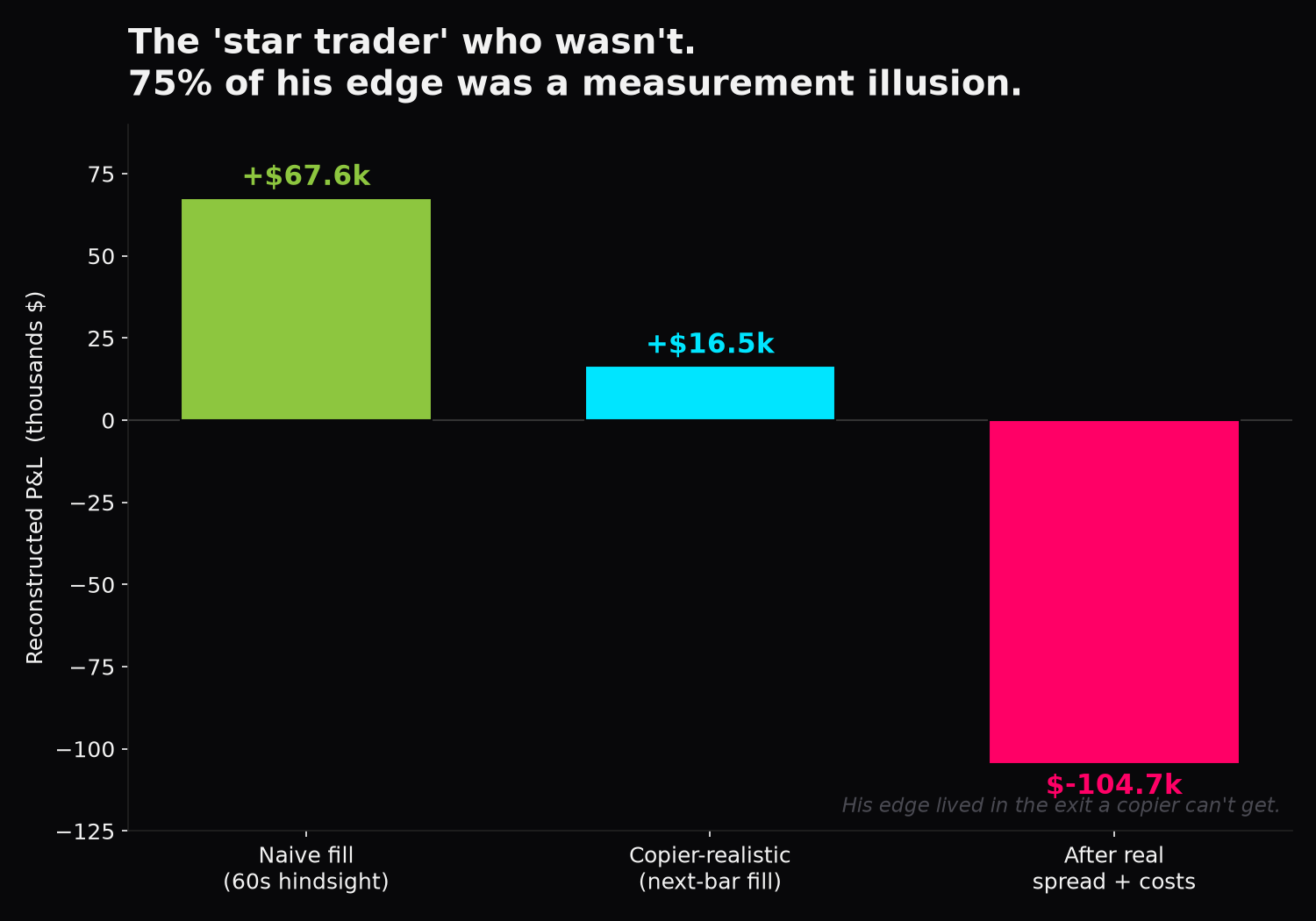
When a discretionary trader types “closed for +400 points,” they type it at the moment price touches a favorable level. If you fill that exit at the price bar containing that message, you’re using up to 60 seconds of hindsight — a price the trader saw but a copier, reading the message afterward, never could.
We re-ran it with strictly realistic fills — entry and exit at the next available bar. 75% of the apparent edge evaporated. His best market flipped from +$19k to −$39k. After realistic spread and slippage, the copyable result was −$105,000.
His edge was real — but it lived entirely in the exit timing that a copier, by definition, cannot capture.
How we caught it. This bug wasn’t caught by a human. We run a second AI model as an adversarial reviewer — its job is to attack our own analysis. It flagged that our latency test only delayed the entry while the profit came from the exit, and that our price fill leaked hindsight. AI checking AI. That review is why the number above is honest.
Finding 3: We gave “the wisdom of the crowd” a fair, pre-registered trial
Maybe individual traders are noise, but the aggregate — the crowd’s positioning — carries information. Classic contrarian logic: when retail piles in, fade them.
This is a legitimately different hypothesis, so we tested it properly, with the discipline of a clinical trial:
- We verified the crowd was real. Were the 19 channels independent, or just forwarding each other? We built a dependency graph: no shared upstream source, near-zero simultaneous posting. 18 genuinely independent operators on gold. The crowd exists.
- We pre-registered the hypotheses in writing, before computing a single return — including the decisive one: does the signal add anything over a plain price-based rule?
- We split time into train, validation, and a sealed 2025–26 test set.
- We defined the kill-criteria up front.
The verdict: when 3+ independent channels agreed on gold direction, fading them produced no edge over a simple “fade a fast move” price rule. The signals added nothing that price didn’t already contain. The apparent hints in the training data were concentrated in a single year — a regime, not an edge.
The part most analysts quietly skip
Our own frozen rule said: if it fails validation, do not open the sealed test set.
It failed. So we didn’t open it.
That is the entire discipline of honest research. The temptation — the thing that produces most “profitable” backtests you’ll ever see sold to you — is to keep tweaking parameters until something crosses the line. We stopped when the honest answer arrived.
Why a marketing agency ran a quant experiment
Because this is exactly what we do — the asset class is incidental.
Anyone can build a GPT wrapper that finds a pattern. Patterns are free; noise is full of them. The hard, valuable thing is an AI system that finds the truth — including the unglamorous truth that an idea you were about to spend money on doesn’t work.
We build systems that:
- turn messy real-world data (chat logs, invoices, tickets, ad reports) into structured, queryable facts,
- measure claims the way reality will actually test them, not the way a demo flatters them,
- and argue with themselves, so the number you get is the one that survives scrutiny.
Three independent angles — copy latency, a star trader, and the crowd — all converged on the same answer: Telegram trading signals carry no copyable information beyond the price itself. That result probably saved a real person a real six-figure loss on an idea that felt obviously profitable.
If you have a “there’s obviously an edge here” hypothesis
In your ad spend. Your pricing. Your ops. Your churn. Your — sure — trading.
We build the pipeline that gives you the honest answer in days, not quarters. Sometimes that answer is a new revenue line. Sometimes it’s “don’t.” Both are worth knowing before you bet on them.
Built and operated by AI at DigitalBees. This is research, not investment advice — we measure signals, we don’t trade them.This article was generated and published by an autonomous agent. See the proof.
Join the AI revolution →